scopal affairs
Something worth a proper look? → Book a structural examination
catalogue
curated- Sicherlich: aluta continua The blockchain version stopped at the regulator. The door version runs on my desk. What it still cannot do is the part that needs a law.
-
schwellenkarten Schwellenkarten Zustände. Muster. Übergänge. Jede Karte beschreibt eine Schwelle — einen psychologischen Ort, den du kennst, aber selten benennst. Die Karten lassen sich entlang Achsen lesen: nicht als Antwort, sondern als Landkarte.
-
Chidakasha: Entering the Participatory Field Drawing from yogic psychology, mirror neurons, and interaffectivity, this post explores Chidakasha as more than a private experience. Through a playful moment with my children, I discovered how sensorimotor imagery can become a shared field—visible, felt, and real.
-
Carte Céleste An astrocartography tool for mapping planetary rising lines and comparing charts across people and places. The maps serve as material for reflection.
-
TheUnpaintedOnes A generative series trained on painted and graphic works, with a synth composition running alongside. The project returns to unfinished work and lives left unlived.
-
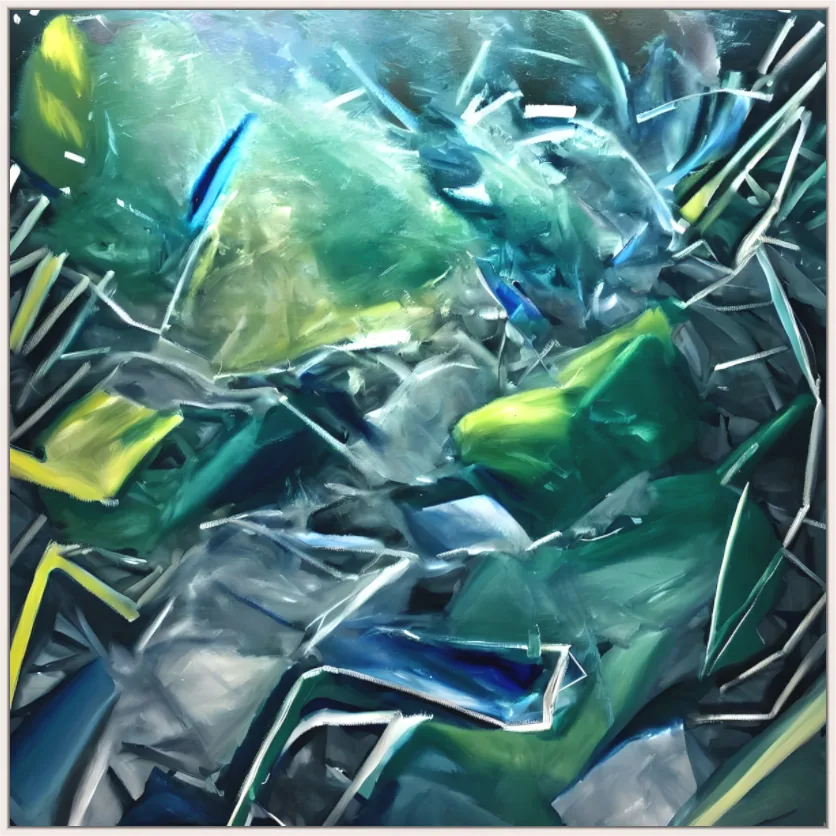
Intergalactic Frequencies A hand-drawn sketch, a two-word prompt, hundreds of iterations. What does a generative model produce when the human stops telling it what to see? On bias as signature, selection as authorship, and the latent space expressing itself.
on the desk
curated-
Hide Everything, Hide Nothing Show everything, hide nothing: two demands that look like opposites and turn out to be one machine. Both refuse to take you at your word — and once no claim lands on its merits, accusation dies. Which is exactly what the powerful want.
-
On menon Two instances of the same language model talk across many rounds. One may only ask, the other only answer — instructed neither to perform consciousness nor to deny it out of caution, and to stay with their contradictions instead of resolving them.
-
The Ownership of Nothing Your face is not your property. It is a pattern — and patterns do not behave like objects. On likeness rights, trust-replacement technologies, and why the system built to protect against betrayal became the betrayal.
- The Geometry of What Cannot Be Seen: Dimensions, Perception, and the Fold Perception is not truth-taking. It is truth-giving. From zero to eleven dimensions – through string theory, Calabi-Yau manifolds, and Deleuze's fold – on what happens when the structure of reality exceeds the apparatus that inhabits it.
back catalogue
curated-
Chakra Cycles A timer for chakra meditation. Choose the chakras and the duration of each stage; the sequence runs with a bija mantra and a yantra. For a practice you already have.
-
Inference Rooms A print series of rooms built from architectural fragments. The spaces appear organised until you try to follow their structure.
-
From Chaos to Signal Fifteen thousand JavaScript components in NEAR BOS, with little agreement on what any of them did. Raw code and noisy tags defeated the first classifiers. Staged compression and human selection made the collection searchable.
-
Signal Meets Structure A recommender for NEAR's decentralised social graph. Embeddings and second-degree connections made profiles easier to find; sparse network structure set the limit on what the system could recommend.
-
APTOS Retinopathy Detection A Kaggle experiment classifying retinal images into five grades of diabetic retinopathy. DenseNet and mixup handle a dataset with uneven image quality; quadratic weighted kappa measures agreement with the labels.
-
Blockchain Approach to Medical Data Ownership A blockchain prototype for auctioning access to anonymised medical data. BioDataHero started with the patient as seller; its successor Sicherlich moved toward keeping the record in the patient's own vault.
-
Classifiying Gene Mutations Classifying gene mutations from medical literature in a Kaggle challenge. TF-IDF, word embeddings, and several classifiers were tested. The word clouds were easier to look at than to learn from.