 scopal affairs
Digital Harvest
An Instagram bot handed out my compliments and brought me around 4,000 followers. A completed experiment in automated care, 2017–2019.
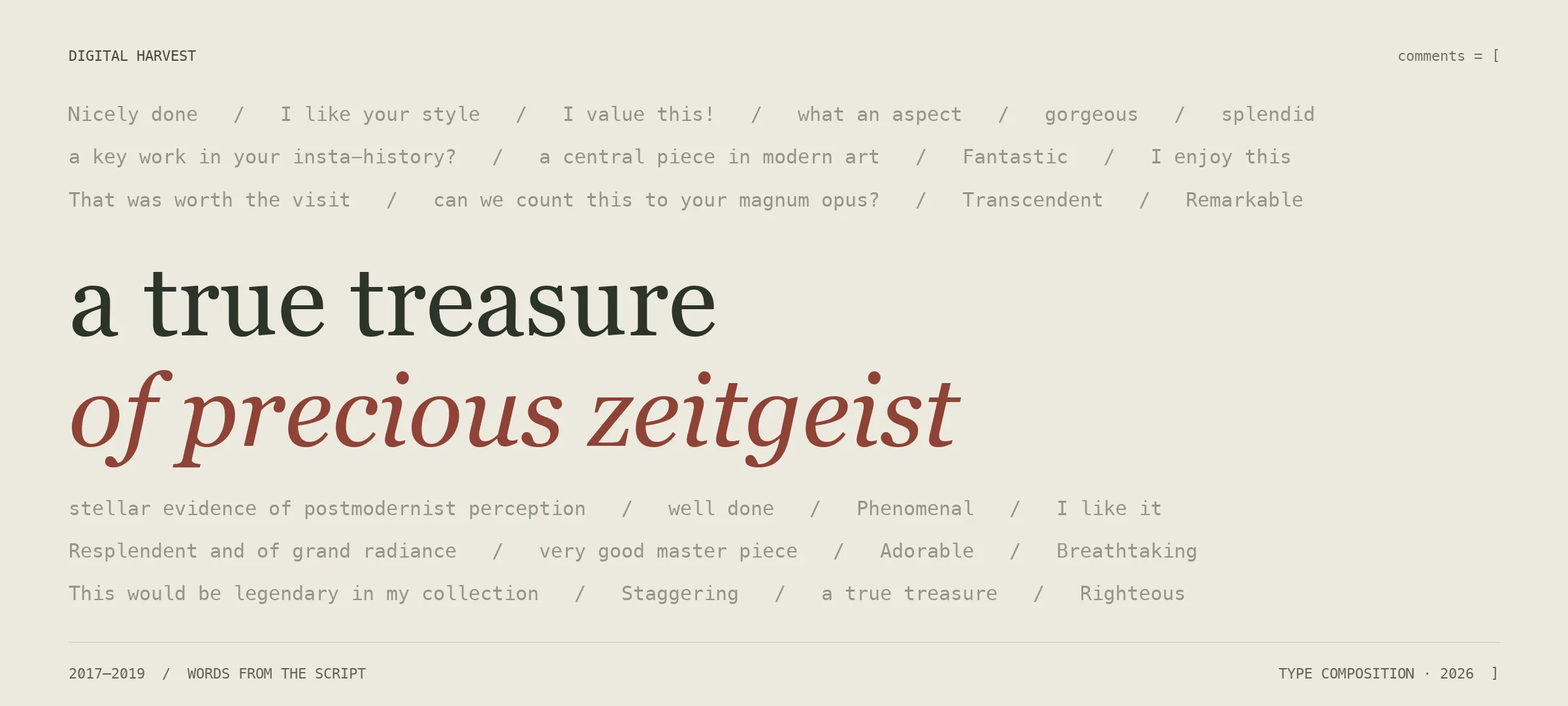
From 2017 to 2019, I let a bot work for my Instagram art account. It liked posts, followed selected accounts and handed out compliments. I wanted to become visible without putting in the daily interaction and consistency that required. I used the open-source software InstaPy. My contribution was choosing whom to approach, setting the rules and, above all, writing the language.
A stock of compliments
I was spreading love. I wrote a stock of comments that moved between plain appreciation, extravagant art talk and a little teasing:
I value this!
a true treasure of precious zeitgeist
stellar evidence of postmodernist perception
can we count this to your magnum opus?
a key work in your insta-history?
This would be legendary in my collection
I had written these phrases myself; the bot distributed them beneath images it found through art hashtags. It had not assessed the individual work. Even so, I remember how well the compliments went down: people enjoyed being addressed and followed my account. Bots were already familiar at the time. A friendly gesture could apparently still have an effect.
I did not want to use the common strategy of following people in bulk and unfollowing them later. I found it unfair and a risk to what I was trying to do. The bot did follow selected accounts; the surviving script contains no unfollow step. Likes and praise were the main approach.
The work behind attention
Through these automated interactions and their regularity, I gained around 4,000 followers. The bot took on work I had no desire to do myself. It made tangible how much ongoing activity a platform can demand before anyone even sees your work.
The cheerful picture of social media, where good work or a successful meme finds an audience overnight, had little to do with my experience. Here, visibility came through repeated contact. Without automation, that activity would have kept me closely tied to the platform. I wanted to keep time for my work and for relationships outside this routine.
At the same time, I benefited when other people experienced the approach as care. My intention was friendly, but each comment was sent without my attention to that particular image. Whatever pleasure someone might have felt, and my interest in growing an audience, both belong to this experiment.
What remains
A public version of the script carries the creation date 14 March 2018. It contains 43 prepared comments and 15 art hashtags. Rules about follower counts and excluded words narrowed the selection; commenting was set to ten percent. Two excerpts show the configuration:
bot.set_do_comment(True, percentage=10)
bot.set_comments(comments)
bot.set_ignore_if_contains(ignore_words)
bot.like_by_tags(tags, amount=100)
bot.follow_user_following(
influencers, amount=15,
randomize=False, sleep_delay=60
)The script records my choices and the intended actions. I no longer have a complete record of the interactions. The follower figure and the responses are my recollections; on their own, they say nothing about how lasting those connections were.
The experiment is complete. What remains here is the language I used to run it, and the experience that an audience could be built through delegated care.
Addendum · 2026
In the same year that this experiment began, Attention Is All You Need was published. In the Transformer it introduced, “attention” refers to a mechanism that weights information according to the relationships between its elements. This computational meaning differs from attention between people. Looking back, I am interested in how relationships in both contexts are organised through selection and weighting.
Closer to my experiment is Michael H. Goldhaber's The attention economy and the Net from 1997. He describes attention as a scarce resource, and “illusory attention” as the impression of personal care in an address directed at many people. I recognise something of my prepared compliments in this: the words could be multiplied, while the recipients' attention remained limited. The bot saved my attention by seeking the attention of others.
Header image: a typographic composition using the surviving comments, 2026.